Important Information about
Team
Registrations, Rosters, and
Tournaments
after August 1, 2012
Locked Rosters on June 1, 2013
The softball "year" for USSSA runs from August 1 to July 31. That means that tournaments scheduled after August 1 are considered 2013 events and in order to participate in them a team must be registered for 2013. In short, all the teams that were created and all rosters that were submitted for the 2012 season expired on July 31, 2012.
Under the USSSA system (ISTS), a manager establishes a one-time account, and then creates teams under that account from year to year. On or shortly after July 1 managers can create their 2013 team, particularly if they plan on playing any USSSA tournaments in August through December. Otherwise, they can certainly wait until next year to create their team.
When a manager creates a 2013 team, he/she will then need to enter their roster online just as they did for 2012. One thing that makes entering your roster easier the second time around is that any player that previously played on a team that the manager has under their account will already be in the system. If the manager wants to retain that player for 2013 (or at least the fall of 2012) then all he/she has to do is highlight the player under the “Add Former Player” section and hit the button.
Now, here’s the catch. The age cut off is still based on the calendar year, however the age eligibility for 2013 teams will change beginning August 1, 2012. The best way to explain this is with an example. Let’s say we have a team that played 14U in 2012. They have a mix of players born in 1997 (roster 14 year olds) and 1998 (roster 13 year olds). If they want to keep playing 14U in the fall of 2012 with players born in 1997 they will not be able to create a 2013 14U team because all 1997 players are now considered roster 15 year olds. What the manager needs to do in this situation is to create their 2013 team as a 15U team. That way he/she can keep all the 1997 players for the fall. Tournament-wise we are going to combine all 14U and 15U teams in the fall because that’s the group that played against one another in the spring and summer. NOTE: No metal cleats in 14U/15U in the Fall.
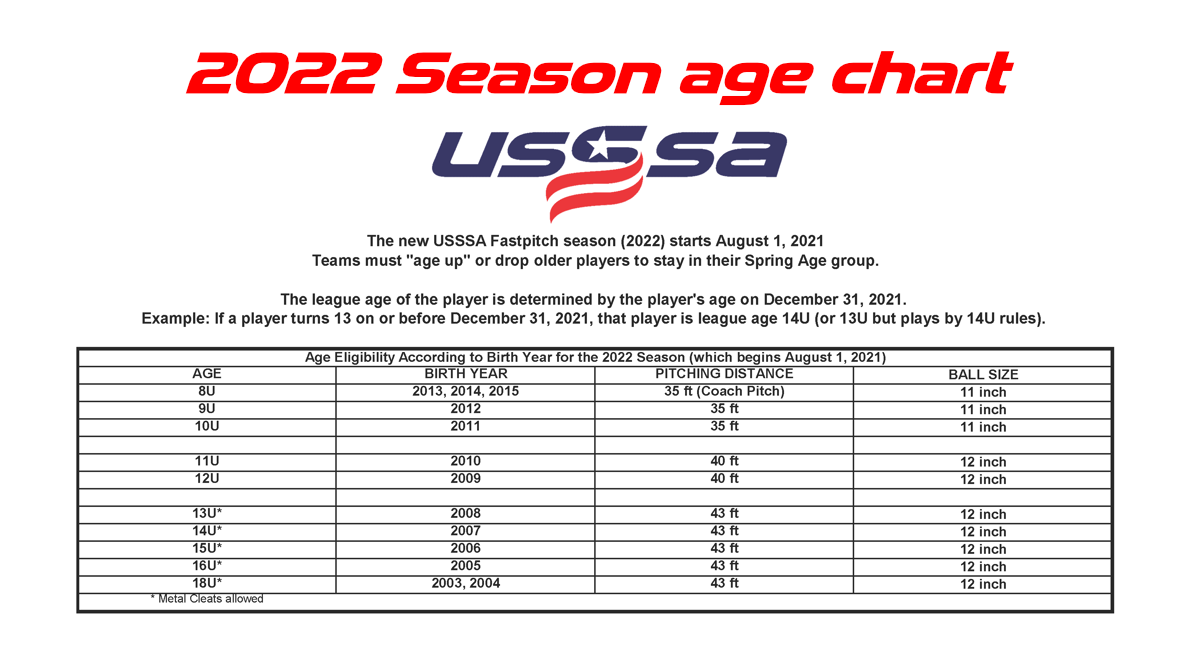
A 14U team was used in the above example, but the same applies to the 8U, 10U and 12U as well. In other words, an 8U manager with 2003 players should create a 9U team (still playing under coach-pitch rules), a 10U manager with 2000 players should create an 11U team and a 12U manager with 1998 players should create a 13U team. Then come tournament time this fall we will combine the 8U and 9U teams (playing under 8U coach-pitch rules), combine the 10U and 11U teams (playing under 10U rules) and combine the 12U and 13U teams. 16U is a slightly different story because USSSA doesn’t have a 17U division. A manager with 1994 players will have to register as an 18U team. Most of the time that won’t matter because in the fall we often combine 16U and 18U age brackets anyway. In cases where we don’t, we’ll simply open up the tournament to 18U teams, but make sure that only 1994 players and younger are on their roster. Below is an outline of age eligibility per age group according to a player’s birth year.
|
Age Eligibility According to Birth Year for the 2013 Season (which begins August 1, 2012) |
|
|
AGE |
BIRTH DATE |
|
8U |
2004 - 2007 |
|
9U |
2003 - 2006 |
|
10U |
2002 - 2005 |
|
11U |
2001 - 2004 |
|
12U |
2000 - 2003 |
|
13U |
1999 - 2002 |
|
14U |
1998 - 2001 |
|
15U |
1997 - 2000 |
|
16U |
1996 - 1999 |
|
18U |
1994 - 1998 |
If a manager creates an odd year team for the fall (9U, 11U, 13U or 15U), then come next spring they have three options:
If they really want to play next spring as a one year younger team, then they should email the state director to have them reclassified as such after the fall season is finished and after they’ve deleted their older players. For example, let’s say a 14U team in 2012 decides they want to play out the rest of the fall with their current players which include 1997 girls. They would register as a 15U in the fall. However, if in the next calendar year they want to be a 14U team again, then the manager would delete any 1997 girls from the roster and call/email the office requesting that they be reclassified to 14U team.
If they want to play next spring as a one year older team, then they would have to let our office know that as well. Following the above example, if a team registers as a 15U team in the fall, but then next spring wants to pick up players born in 1996, then we would have to reclassify them as 16U.
They can do nothing and just stay as an 9U, 11U, 13U or 15U team for the spring/summer of 2013.
There are two other side issues to all of this.
Insurance. The insurance situation changes depending on whether the team purchased their insurance from USSSA or from another association.
If a team has USSSA insurance: Teams that purchased USSSA had two options when they bought it – to have coverage run through 7/31/12 or have it run through 12/31/12. If they purchased the latter policy then they’re fine through the fall. If they purchased it to expire on 7/31/12 then they’ll need to purchase another policy that runs from 8/1/12 to 12/31/12, which USSSA offers at half price because of the shortened term. Or they can purchase a full “year” policy that runs from 8/1/12 to 7/31/13 which will cover them through the 2013 registration period.
If a team does not have USSSA insurance: Most non-USSSA policies expire on December 31. If a team has such a policy then it will remain in effect throughout the fall provided that the team is essentially the same. If a 12U team becomes a 13U team in the fall, but otherwise carries the same team name, then their 2012 coverage will apply provided any newly added players are included on the team’s roster. However, if the team name completely changes then a new policy would be required.
Player Pickup Policy. We realize that many teams and players use the fall and early spring as a “try out” period, such that neither managers nor players necessarily want to be locked onto one another until July 31, 2013 just because they played in an August 2012 tournament. Therefore, here’s how we handle rostering players for the fall of 2012 and early spring (through June 1) of 2013: For a player to participate on a team in a fall tournament she must be on that team’s roster and have signed it. If she then plays on another team in the fall all she has to do is be added to the second team’s roster and sign that one as well. She does not have to submit a player release form, nor does she use up her one-time release privilege. We do not encourage roster-jumping or guest-playing, but theoretically, she can play for as many different teams in the fall and early spring (through June 1) as she wants as long as she’s added to each team’s roster, signs it and has it turned into the Tournament Director prior to participating in a tournament.
Then once that player participates in a tournament after Jun 1 of the next calendar year, she’ll be committed to the first team she plays on in 2013, and will be given a one-time release privilege at that point.
NOTE: During the "try-out" period, players on A teams should not play down on B teams unless approved by the State Director. B players from an older age group should not play down on a younger B team unless approved by the State Director. Adding an "A" player to your roster may jeopardize your "B" status.
Other Roster Notes
As stated above, Florida USSSA allows open rosters until June 1. A player may play on several teams before that as long as she is not on two USSSA teams playing tournaments the same weekend. After June 1, I will lock all rosters, then all player moves from one team to another must be approved by me.
Hopefully this answers any questions that managers and players have regarding the USSSA softball “year.”